

Manufacturing Industrial Tanks and Equipment: Standards & Fabrication Process
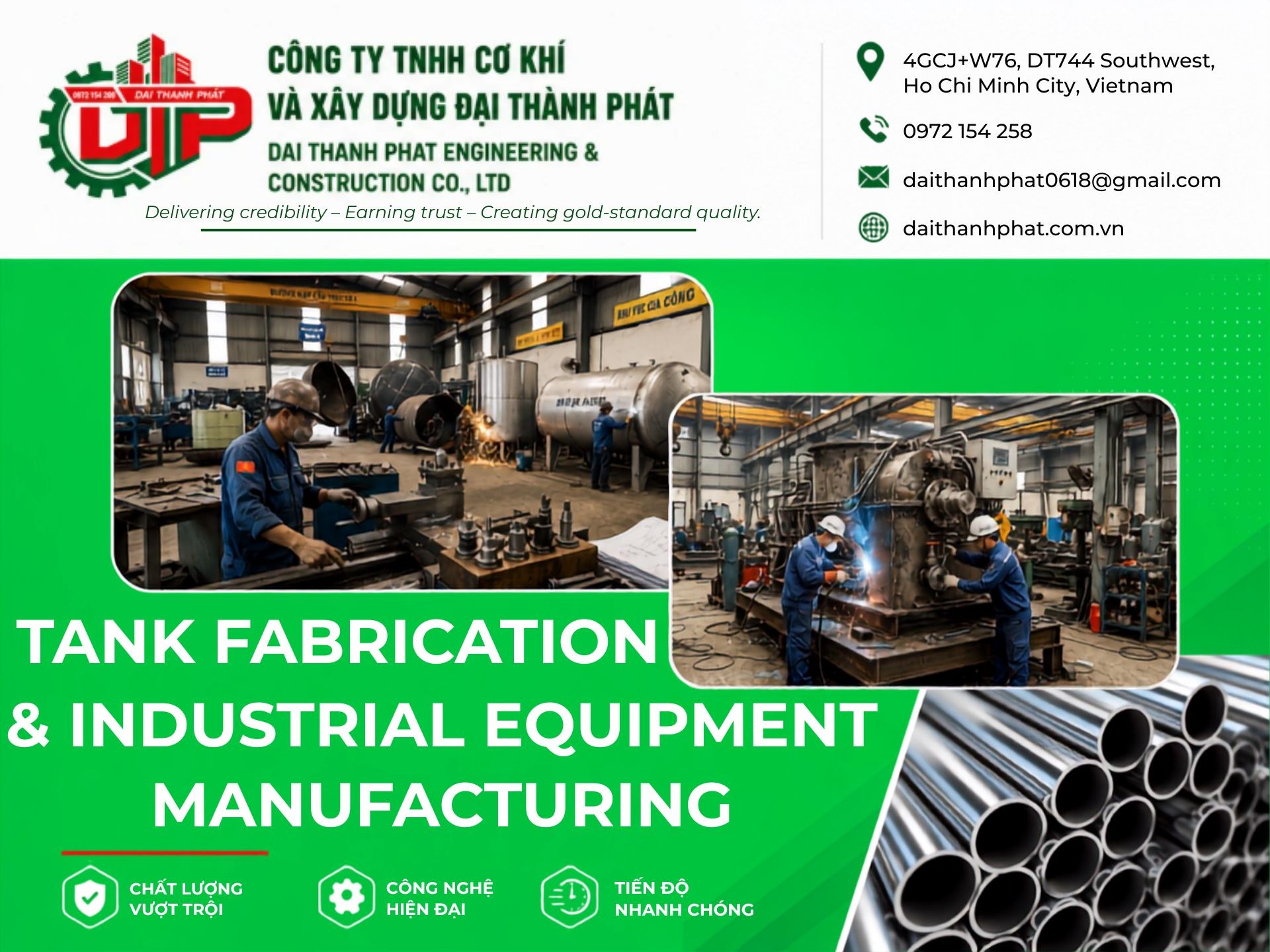
Tanks and machinery systems are the "heart" of every factory. They directly determine the efficiency of the production line. Therefore, investing in standard-compliant manufacturing industrial tanks and equipment is essential. This helps ensure operational safety. It also optimizes long-term costs. This article will share details about technical standards. You will also understand the most professional fabrication process today.
1. The Role of Tanks and Industrial Equipment in Plants
Storage systems and mechanical equipment play an irreplaceable role. They participate in almost every stage of the production line. Below are the most crucial roles.
1.1. Safe Storage and Preservation of Materials
Every factory needs space to store large volumes of materials. Industrial storage tanks solve this problem perfectly. They are designed to be absolutely airtight. This prevents the leakage of toxic chemicals. As a result, the working environment is always kept safe. Material quality is also not affected by the external environment.
1.2. Optimizing Closed Operational Efficiency
The combination of tanks and machinery creates a closed system. The material flow is circulated continuously without interruption. Synchronized manufacturing industrial tanks and equipment reduces manual labor. The automation process is significantly improved. Because of this, the productivity of the whole factory increases significantly.
1.3. Ensuring Lifespan and Durability for Projects
Standard industrial equipment always has very high durability. They can withstand immense pressure and extreme temperatures. Using quality fabricated products reduces the risk of breakdowns. Businesses will save a lot of annual maintenance costs. The project's lifecycle is also maximized.
2. Classification of Popular Industrial Storage Tanks
Depending on the specific industry, tanks are divided into many types. Each type will have a distinct design and material.
2.1. Specialized Chemical Storage Tanks
This type of tank requires the strictest technical requirements. They are usually used to store acids, caustic soda, or strong solvents. Fabrication materials are mainly FRP-coated steel, PP, or PVC plastic. An internal anti-corrosion layer is a mandatory requirement. It helps prevent dangerous chemical reactions.
2.2. Food-Grade Industrial Stainless Steel Tanks
The food and pharmaceutical industries require very high microbiological standards. Therefore, storage tanks are usually made from 304 or 316L stainless steel. The tank surface must be perfectly mirror-polished. This prevents bacteria from clinging to the tank walls. The CIP (Clean in Place) process is also much easier.
2.3. Industrial Zone Wastewater Treatment Tanks
This system requires an extremely large storage capacity. Wastewater treatment tanks are often made from SS400 steel or stainless steel. The tank structure must be rigid enough to withstand water pressure. Internal agitators are often integrated inside the tank. The exterior anti-rust Epoxy coating increases product lifespan.
2.4. High-Pressure Storage Tanks
Pressure tanks are specifically used to store compressed air, gas, or steam. The bottom of the tank usually has a spherical dome shape to distribute force. The steel thickness must be calculated extremely carefully. Any error can lead to a risk of explosion. Ultrasonic welding inspection is a mandatory step for this tank type.
3. Strict Standards in Fabrication and Manufacturing
To produce a complete product, mechanical workshops must follow many standards. Transparency regarding standards is a measure of the manufacturer's prestige.
3.1. Raw Material Manufacturing Standards
Material is the core factor determining equipment quality. Every steel plate, pipe, or flange must have clear CO/CQ certificates. For chemical environments, manufacturers must use special alloy steel. Choosing the wrong material can instantly destroy the entire system.
3.2. Design Drawing and Pressure Standards
All manufacturing industrial tanks and equipment drawings must be carefully approved. Engineers often apply international standards like ASME or API 650. Wind and earthquake load calculations are also included in the drawing. Safety factors are always placed at the highest priority level.
3.3. Weld Quality Inspection Standards
The weld is the most vulnerable spot for leaks on the tank body. Therefore, the Non-Destructive Testing (NDT) process is extremely important. Inspectors will use X-ray or Ultrasonic Testing (UT) methods. If bubbles or tiny cracks are detected, the weld must be redone. This stage ensures absolute safety for the operator.
4. Standardized Fabrication Process for Tanks and Equipment
A standardized workflow helps ensure project schedules. Customers can also easily monitor and accept each stage. Below are 6 professional fabrication steps.
4.1. Step 1: Site Survey and Technical Drawing Design
Engineers will go directly to the factory to measure the space. Then, they brainstorm and create detailed 2D/3D drawings. This drawing clearly shows dimensions and connection pipe locations. Customers will finalize the drawing before the workshop cuts the materials.
4.2. Step 2: Material Selection and Cutting Process
Materials are imported into the warehouse and checked for quality. Mechanics use Plasma cutters or CNC lasers to cut the steel plates. CNC machine precision helps the pieces fit together perfectly. After that, the metal sheets pass through rolling machines to form cylinders.
4.3. Step 3: Welding Assembly and Fabrication
The parts are joined together using TIG or MIG welding methods. Workshops often use automatic welding machines to create beautiful, even welds. The welder's skill plays a decisive role in this step. All welders must have international pressure welding certificates (like 3G, 6G).
4.4. Step 4: Non-Destructive Testing and Hydrostatic Testing
After welding is complete, the equipment must undergo rigorous testing. Water is pumped full into the tank and pressure is held for 24 hours. If there is no pressure drop or water leak, the tank passes. Ultrasonic weld inspections are also performed in parallel.
4.5. Step 5: Surface Treatment and Finishing Paint
The metal surface is sandblasted or shot-blasted to clean off rust. Then, workers apply coating layers according to requirements. Usually, there is one primer layer and two Epoxy color layers. For stainless steel tanks, workers will use polishing machines to achieve the required roughness.
4.6. Step 6: Packaging, Transportation, and Installation
The finished product is carefully wrapped in shrink film to prevent scratches. The manufacturing company will use specialized cranes to transport it to the site. The technical team directly installs, connects, and test runs it. After the system operates stably, both parties sign the handover minutes.
5. Criteria for Choosing a Reputable Mechanical Partner
There are many mechanical fabrication workshops in the market today. However, not every unit is capable of executing large projects. Please consider the following criteria.
5.1. Machinery Capacity and Factory Scale
A reputable manufacturing workshop needs to have a spacious area. They must be fully equipped with modern machinery. CNC cutting machines, hydraulic plate rolling machines, and gantry cranes are mandatory. Good machinery systems help accelerate the fabrication progress. It also increases the precision of the finished products.
5.2. Company Profile and Practical Experience
Ask your partner to provide their company profile. You need to review similar projects they have executed. A unit with many years of experience will know how to handle risks. They deeply understand the characteristics of each chemical and material type.
5.3. Lifetime Warranty and Maintenance Policy
After-sales service is the strongest commitment to quality. Reputable units are always ready to provide a 12 to 24-month warranty. They have a quick-response technical team when problems occur. This companionship keeps your factory running smoothly at all times.
6. Get a Quote for Manufacturing Tanks and Equipment in 2026
Fabrication prices do not have a common fixed rate for all products. Costs depend heavily on the investor's technical requirements.
6.1. Factors Affecting the Quotation
Tank size and capacity are the first factors determining the price. Premium fabrication materials (like 316 Stainless Steel) will be more expensive. In addition, material thickness and included accessories also affect costs. Special inspection requirements will also be added to the total quote.
6.2. How to Contact for a Free Consultation
For the most accurate price list, you should send a preliminary design drawing. Our engineering team will break down the detailed quantities. We commit to bringing optimal solutions at the most reasonable costs. Please contact us directly via Hotline or Sales Department Email.
Hotline / Zalo: 0972154208
Email: daithanhphat0618@gmail.com
Workshop Address: Land Parcel No. 3320, Map Sheet No. 13, Rach Bap Residential Area, Long Nguyen Ward, Ho Chi Minh City, Vietnam.
7. Conclusion
Finding a reliable manufacturing industrial tanks and equipment partner is a crucial stepping stone for every factory. Quality products not only optimize production lines but also protect workers' lives. Hopefully, this article has provided you with the most useful technical knowledge. Choose a highly experienced fabrication unit to entrust your project with!